A Winter Walk for Reading the Sky
A winter walk for reading the sky helps you distinguish cloud layers, changing brightness, and low visibility without turning a country walk into a forecast.
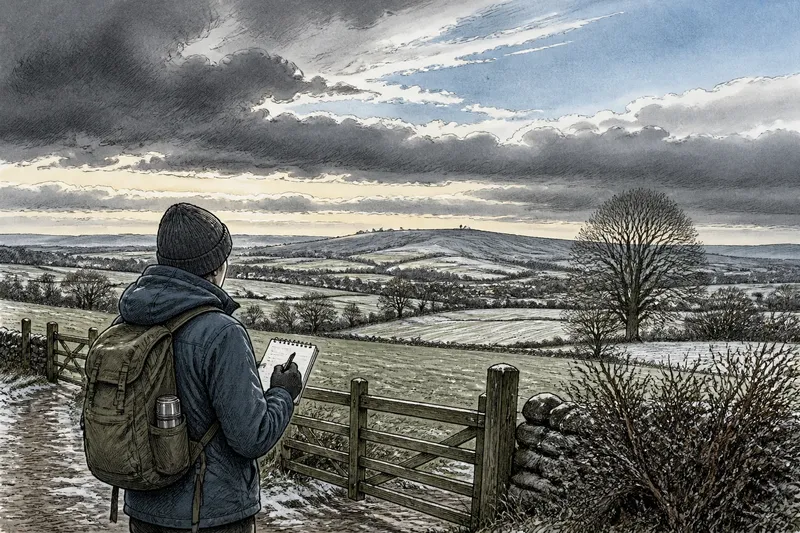
The common mistake on a winter walk is to treat the sky as scenery until rain or snow starts. That costs you the chance to notice how cloud, visibility, and light are changing before the weather becomes obvious. A winter walk for reading the sky is more useful when you follow those clues in relation to the land around you.
Winter’s bare branches and open fields make the edges of cloud and distant features easier to see. A ridge may stand out against a pale strip of sky, while a darker layer hangs above it. These details can help you describe current conditions, but they are not a dependable forecast on their own.
Read the cloud edge
Begin at a safe place with an open view, such as a village green, a field gate, or a public path beside farmland. Look at the boundary between cloud and land. Notice whether the ridge or tree line is sharply outlined, partly blurred, or hidden. That boundary gives you a steady reference for describing what the sky is doing.
Compare the cloud nearest the horizon with the cloud overhead. A broad, even gray area may look like a low ceiling; thinner streaks or a pale veil can appear above or beyond it. Exact cloud names are not necessary. Plain descriptions such as “flat gray layer over the ridge” or “broken patches with blue between” are easier to verify on a later walk.
If the horizon is hidden, use another visible edge, such as a roofline or a stand of trees. Record that the view is obscured rather than guessing what lies behind it.
Separate light from visibility
A dim landscape does not always mean poor visibility. The ground can remain dark beneath thick cloud even when distant fields are distinct. Conversely, a bright opening in the sky may leave far details hazy. Check the land and sky separately: note the brightness of the ground, the appearance of cloud, and whether recognizable features at a distance remain clear.
Look for differences across the scene. One slope may catch a brighter patch while a nearby hollow stays shaded. A pale gap near the horizon may change the appearance of the sky without making the fields brighter. Bare hedges and branches can help you see contrast because they no longer merge with dense foliage.
Say you start beside a lane under an even gray sky. At a safe field gate, you see the far ridge clearly but the ground looks dull; later, a brighter opening appears above the ridge while the fields remain muted. Your note can distinguish visibility from brightness: the distant edge is still clear, and the sky has brightened, but the land has not.
Notice movement carefully
To judge whether cloud is moving, use a fixed feature such as a hilltop or chimney as a reference. Observe how a cloud edge sits against it, then check again after a short pause. A change in your viewing angle can make cloud seem to shift, so describe only what you can see rather than estimating wind speed.
Different layers may appear to move in different ways. A low gray bank might cross a ridge while thin streaks remain visible above it. Nearby grass or branches can show that wind is present at your location, but shelter from buildings and trees may make conditions feel different elsewhere on the route.
If wind, poor footing, or fading light makes the walk uncomfortable, head back rather than lingering to observe. Choose a sheltered place to pause and keep clear of roads, gates, and other people using the path.
Keep observations useful
A notebook or phone note is enough to keep a simple record. Write the time, the direction you faced if known, and a few concrete details: “ridge clear,” “low cloud over the trees,” or “ground still dim beneath a brighter sky.” A small sketch of the horizon can clarify where a cloud band appeared.
On another day, read the notes for descriptions of the place rather than rules about what weather must follow. You may learn that a particular hill blocks your view of the lower sky, or that a bend gives you a clear look toward the horizon. Those are useful limits on what you can observe from that route.
- Check whether the horizon is visible; if it is, use it to describe cloud position, then note an alternate edge such as a tree line if it is not.
- Check whether distant features are distinct; if they are, record good visibility, then note that distance is obscured if they are not.
- Check whether the sky and ground have similar brightness; if they differ, describe each separately, then record an even, subdued appearance if they do not.
- Check for cloud edges against a fixed feature; if an edge shifts during your pause, note apparent movement, then record no clear movement if it stays aligned.
- Check whether wind or footing makes stopping uncomfortable; if either does, shorten the observation and return, then continue only from a sheltered, safe spot if conditions allow.
- Check whether your view is blocked by trees or buildings; if it is, move only to a nearby safe opening, then record the obstruction if no suitable opening is available.
What should you watch for?
How can I tell cloud layers apart?
Compare their apparent height, texture, and position relative to the horizon. Describe a broad low-looking layer separately from thin streaks or a pale veil, without relying on a precise cloud name.
Why does the landscape look unevenly lit?
Cloud, hills, and buildings can block low winter sunlight from reaching one part of a view while another remains brighter. Compare specific features, such as a slope and a hollow, instead of calling the whole scene bright or dark.
What if the horizon is hidden?
Use the clearest available boundary, such as a roofline or tree line, and note that the distant view is obscured. Move to a more open spot only if it is safely accessible.
Can a short walk predict later weather?
No. Your view covers only part of the sky, and cloud can approach from beyond the landscape you can see. For plans that depend on conditions, check a suitable forecast as well as your outdoor observations.
Use the view, not a verdict
Good notes stay close to what you can see: “thin pale band above the ridge” says more than “the weather is clearing.” The first describes an observation; the second makes a prediction that the view alone may not support.
Keep the winter walk for reading the sky focused on cloud position, visibility, and differences in brightness. Those observations make a familiar country view easier to interpret, while checking a forecast remains the better choice when you need to plan for changing conditions.