The Weathered Wall: A Short History of Farm Building Materials
Farm building materials reveal how local stone, timber, brick, and concrete met changing needs, helping you read a weathered wall as a record of place.
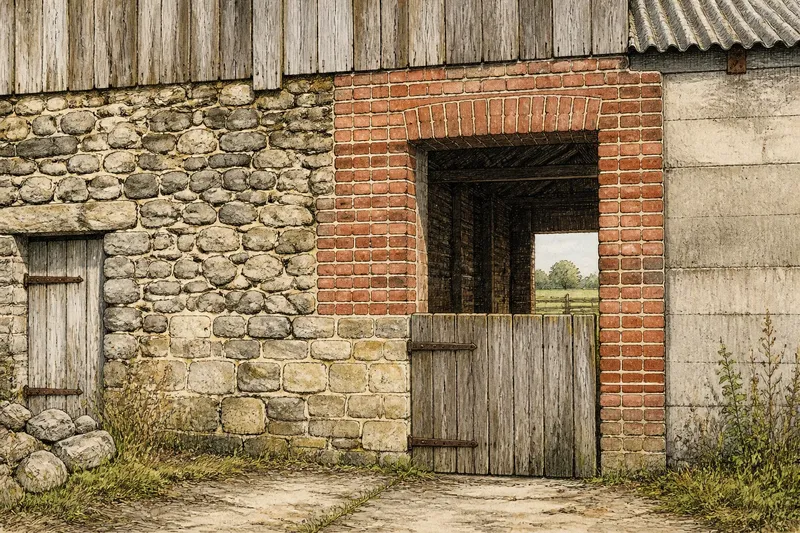
The most common mistake when reading a farm building is to treat its wall as one unchanging surface. That can hide the cost of a closer look: a stone base, brick patch, timber bay, and concrete panel may belong to different building needs and periods. Farm building materials are clues to how local resources and practical demands shaped the countryside.
Begin with what the wall is made of, then notice where one material stops and another begins. The sequence is often more revealing than the appearance of any single stone or board. A building may have started as a modest store, then gained a wider opening, a more weather-resistant roof, or a new enclosure as farming changed.
Materials at hand
Before transport and manufactured products became easy to obtain, builders commonly relied on what could be gathered or worked nearby. That might mean fieldstone cleared from cultivated ground, timber from local woodland, clay shaped into bricks, or earth mixed with fibers. “Local” does not mean identical across a region: geology, woodland, soil, and building customs all vary over short distances.
Stone walls may be built from roughly shaped pieces, carefully squared blocks, or a mixture of both. A rough face can suggest that appearance mattered less than making use of available stone, but it does not by itself establish the building’s age or purpose. Look at the corners and around openings, where better-shaped stones may have been used to carry weight or form a neat edge.
Timber offered a different set of possibilities. A frame could support a roof and leave space for broad doors, while boards or woven material filled the gaps. In some places, timber was scarce or costly; elsewhere, it was a practical choice. Weathering, repairs, and later cladding may conceal the original frame, so exposed joints and the shape of openings can help you notice what remains.
Clay, earth, and brick also tell a local story. Sun-dried earth or clay-rich materials could be useful where suitable stone was limited, while fired brick required fuel and deliberate manufacture. Brick details around corners or windows may mark a change in construction rather than a purely decorative choice.
Read the material as evidence of availability, not as a label for a whole landscape.
Farm work and form
A farm building’s shape followed the work it had to contain. A store needed protection from rain and pests; a byre needed an interior suited to animals; a barn required space for crop handling and storage. These uses influenced wall height, door width, ventilation, and the relationship between enclosed rooms and open-sided shelter.
Broad openings are especially useful clues. A large doorway may have accommodated carts or equipment, while a smaller entrance could serve people or livestock. Yet an opening may have been widened or filled in later. Check whether the lintel, jambs, and nearby masonry match the surrounding wall; a change in stonework or a seam in the surface can reveal an alteration.
Materials also affected how a building managed damp and wind. A thick wall of stone or earth could provide a solid enclosure, while a timber-framed structure could be adapted with boards or other infill. Roof edges, eaves, and the bases of walls often show where water has repeatedly run or collected. These marks help explain why owners patched one area and rebuilt another.
Imagine a small stone store with a narrow original doorway and a later brick-edged opening. If the newer brickwork cuts across older stone, the likely reading is not that the wall was built all at once, but that access changed as the building’s use changed. The visible result is a broad entrance framed by a material that differs from the older wall.
Farm building materials?
What can a stone wall reveal?
Stone type, shaping, and placement can suggest what was readily available and how carefully the wall was built. Look for differences at corners, openings, and repairs before drawing conclusions from the wall’s general roughness.
Why do old walls have different materials?
Buildings were often altered as work, access, or weather protection needs changed. A patch or addition may record that practical adjustment, although a surface difference alone cannot identify its exact date.
Can brickwork show an extension?
It can offer a clue when its courses meet older masonry at a clear seam or interrupt an earlier opening. Compare mortar, alignment, and the way the materials join rather than relying on color alone.
What does concrete say about a farm building?
Concrete often signals a shift toward manufactured materials and surfaces suited to particular forms of use, such as hard-wearing floors or later wall repairs. Its presence does not, by itself, tell you when the work happened or what the building was used for.
Repairs leave a record
Farm walls are rarely pristine examples of one building method. A farmer might replace a damaged timber section, add brick around a weak opening, or cover an uneven wall with a later finish. Each intervention answers a particular problem, and the new material can make the older structure easier to read if you look for joins rather than treating every patch as visual clutter.
Mortar is one useful detail. A change in texture, color, or joint width may mark a repair, but weather and staining can also alter its appearance. Compare protected and exposed areas: under an eave, mortar may retain a different surface from mortar exposed to driving rain. This comparison can separate a construction difference from simple weathering.
Infill deserves similar care. A blocked window, a wall built across an open bay, or boards fitted between older timbers can record a change in the building’s role. The older outline may remain visible as a shallow recess, a line of mismatched joints, or a break in the wall’s rhythm.
Do not assume the newest material is always the least important. A concrete apron, metal door, or brick support may have changed how a building functioned, even if it covers only a small area. The scale of a repair does not tell you how much it mattered to the work carried out there.
Reading a wall in place
Step back first to see the whole elevation: its openings, roofline, and relationship to nearby sheds or yards. Then move closer to inspect a few features that can be checked without disturbing the building:
- Wall base: Notice whether the lowest courses use larger or more resistant-looking stones than the upper wall.
- Corners: Compare the corner material with the broad wall surface for signs of deliberate shaping or later rebuilding.
- Openings: Look for a change in material or alignment around doors and windows that may indicate enlargement or blocking.
- Joints: Compare mortar in sheltered and exposed places before deciding whether a difference signals repair.
- Infill: Check for timber, brick, boards, or other material set within an older frame or opening.
- Water marks: Notice staining, worn edges, and damp at the base as signs of how weather has affected the surface.
Keep descriptions separate from interpretations. “Brick courses cross the stonework beside the door” is an observation; “the doorway was widened” is a plausible reading. That distinction leaves room for other explanations, such as a repair that followed damage.
Weather and changing surfaces
Weather does not simply age a wall evenly. Wind-driven rain may wear one face more than another; shade can keep a surface damp; frost can loosen vulnerable joints. Lichen and dark staining may mark enduring moisture, but they are not reliable clocks. Their presence depends on exposure, shade, and the material itself.
Land use can alter the way weather reaches a building. A hedge removed from one side may leave a wall newly exposed, while a later lean-to can shelter part of an older surface. Nearby ground levels can also shift, covering lower courses or bringing damp closer to the wall. What appears to be a difference in materials may partly reflect different exposure.
Read the building in changing conditions when you can. Low sun can reveal shallow joints and uneven repairs; overcast light often makes color contrasts less pronounced and helps show the wall’s overall form. Neither view is definitive. The useful question is what remains visible from more than one angle and under more than one kind of light.
Farm building materials turn an ordinary wall into a record of resource, work, repair, and exposure. Pair close observation with a simple sequence: note the material, locate its boundaries, and ask what changed at that point. A seam is not a complete history, but it gives you a precise place to begin looking again.