The Green Field Myth: Why Colour Alone Can Mislead
Green field colour can suggest growth, but texture, boundaries, tracks, and weather help you describe a countryside view without guessing at land use.
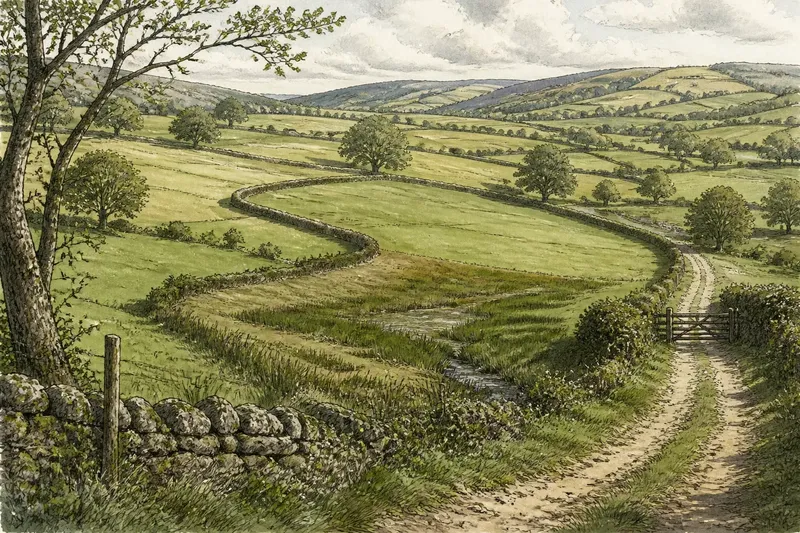
The common mistake in reading a green field is to treat its vividness as proof of what is growing or how the land is managed. Green field colour can draw the eye, but relying on it alone can turn a quick impression into an unsupported claim. Start with what you can see: surface texture, height, edges, tracks, and how the view changes across the field.
Colour and light
A bright, even green surface may suggest a uniform crop or fresh pasture, yet different conditions can produce a similar appearance. Young grass, an early cereal crop, and vegetation after rain may all look like a smooth green block from a distance. Colour gives you an initial impression, not an identification.
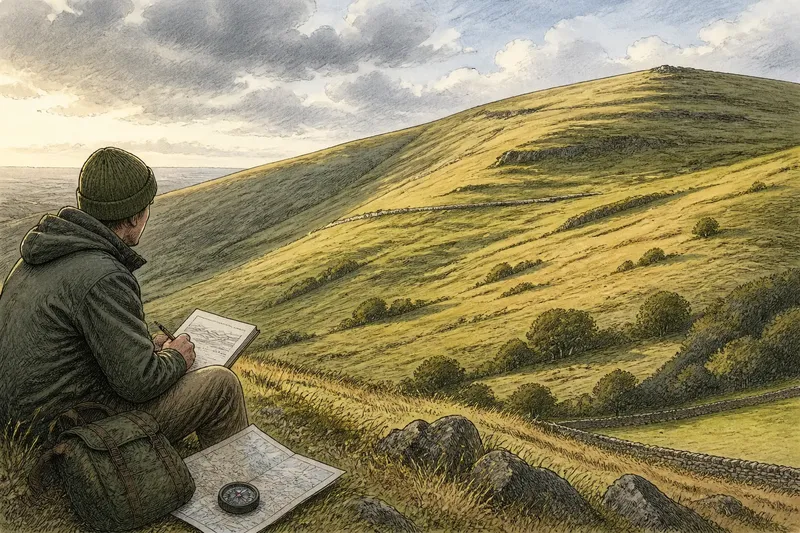
Light can alter that impression. Low sun may make one slope look luminous while a neighboring field appears dull; a passing cloud can shift the same ground from bright to muted. Wet leaves may reflect more light, and haze can soften differences between shades. Note the light and weather alongside the color rather than treating the color as fixed.
“A vivid green field with a smooth surface” records visible features. “A field of young grass” makes a claim about what is growing. Use the first description until other clues support the second.
Surface patterns
Texture can distinguish impressions that color alone blends together. Look for repeated rows, fine upright blades, broad leaves, patches of different height, or a rough mix of plants. Distance, wind, and viewing angle may hide these details, so record what you can resolve and what remains indistinct.
Look for variation within the field, too. A dark strip might follow a hollow or a line of shade; pale patches might be exposed soil, dry vegetation, or a change in reflected light. A boundary between two tones is worth noting, but it does not explain the cause by itself.
Describe the pattern before naming a crop: “short, even growth, with a darker band along the lower edge.” That wording leaves room for correction.
Boundaries and tracks
Field edges provide context that the central green surface may not. A hedge can divide grazing ground, shelter a crop, or mark an older boundary; a ditch may carry water or simply shape the edge. A gate, fence, or opening shows where access is possible, not necessarily how often the field is used.
Tracks deserve the same care. Parallel wheel marks may indicate machinery, while a narrow worn line could be made by people or livestock. Note where a track begins and ends, whether it crosses the field, and whether it looks fresh or softened by vegetation. A single mark rarely settles its cause.
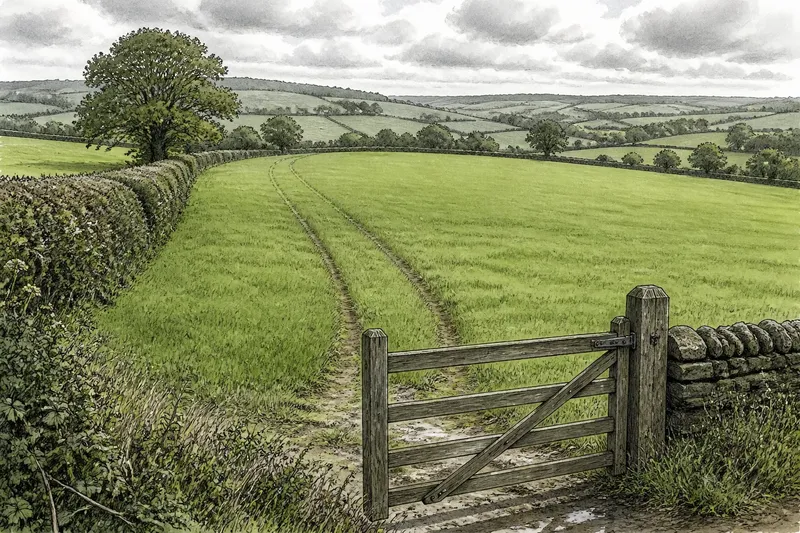
Say you stand beside a lane and see a bright field, two parallel lines, and a gate at one corner. You note the green surface, the paired tracks, and the gate’s position, but leave the field’s use open. The resulting description preserves useful clues without turning them into an unsupported story.
Field note decisions
Use each visible clue to decide what you can responsibly record. These checks keep observations specific while separating them from explanations:
- Check whether the color is even or patchy. If it is even, record a uniform appearance; if it is patchy, describe the location of the contrasts instead of assuming different plants.
- Check whether rows are clearly visible. If they repeat across the field, note their direction and continuity; if they are indistinct, leave crop identification open.
- Check whether the surface shows blades, broad leaves, or mixed texture. If a form is clear, describe it; if it is not, record only the general texture.
- Check whether a dark or pale band follows a slope, hollow, hedge, or shadow. If it does, note that alignment; if it does not, record the band without assigning a cause.
- Check whether tracks connect an entrance to another edge. If they do, describe their route; if they stop or fade, note where they become unclear rather than inferring their purpose.
- Check whether the ground looks wet and whether the light is direct, diffused, or changing. If either condition affects visibility, include it in the note; if not, record the visible features without attributing color to weather.
Imagine you are standing at a lane gate on an overcast afternoon. In this invented situation, you can see an evenly green field, two parallel marks that fade near the middle, a hedge along one side, and no clear leaf or blade detail. First, write the view and weather: “Even green surface under overcast light.” Next, add what the marks do: “Two parallel tracks enter from the gate and fade near the middle.” Then record the boundary: “Hedge along the left edge.” Because the vegetation and tracks do not reveal a definite crop or use, your final note describes the surface, route, and edge while leaving both interpretations open. That is more useful than naming a crop based on color alone.
Questions about green field colour?
Does bright green mean a field is pasture?
No. Different vegetation can look bright green, particularly from a distance or in strong light. Describe the surface and its visible pattern before calling it pasture.
Can rows identify a crop?
Rows can be a useful clue, but they do not always identify what is planted. Note their direction and whether the pattern continues across the field; name a crop only when other visible details support that reading.
Why does one field look greener than another?
Differences may come from vegetation, moisture, slope, shade, or the angle of the light. Compare the fields under similar viewing conditions before treating color contrast as evidence of different land use.
What should I write when I am unsure?
Use observable terms such as “even green growth,” “rough patches,” or “a pale strip beside the hedge.” If you add an interpretation, mark it as a possibility and name the clue that prompted it.
Record changing views
Fields change with growth, cutting, grazing, rain, and season. A field that appears lush from the lane may look different at its edge, and a view under one sky may not match the next visit.
When a detail matters, record the conditions that frame it: whether the ground looks wet, whether the light is direct or diffused, and whether the vegetation appears uniform or patchy. If you return, compare the same visible features rather than relying on memory of the overall shade.
Keep the note compact: place, viewpoint, conditions, then visible details. Green field colour is most useful when it sits alongside texture, boundaries, and tracks—not when it has to carry the whole description. On your next walk, write down one detail you can point to before deciding what the field might be used for.